Midlife Movement for Women: Protecting Brain and Joint Health
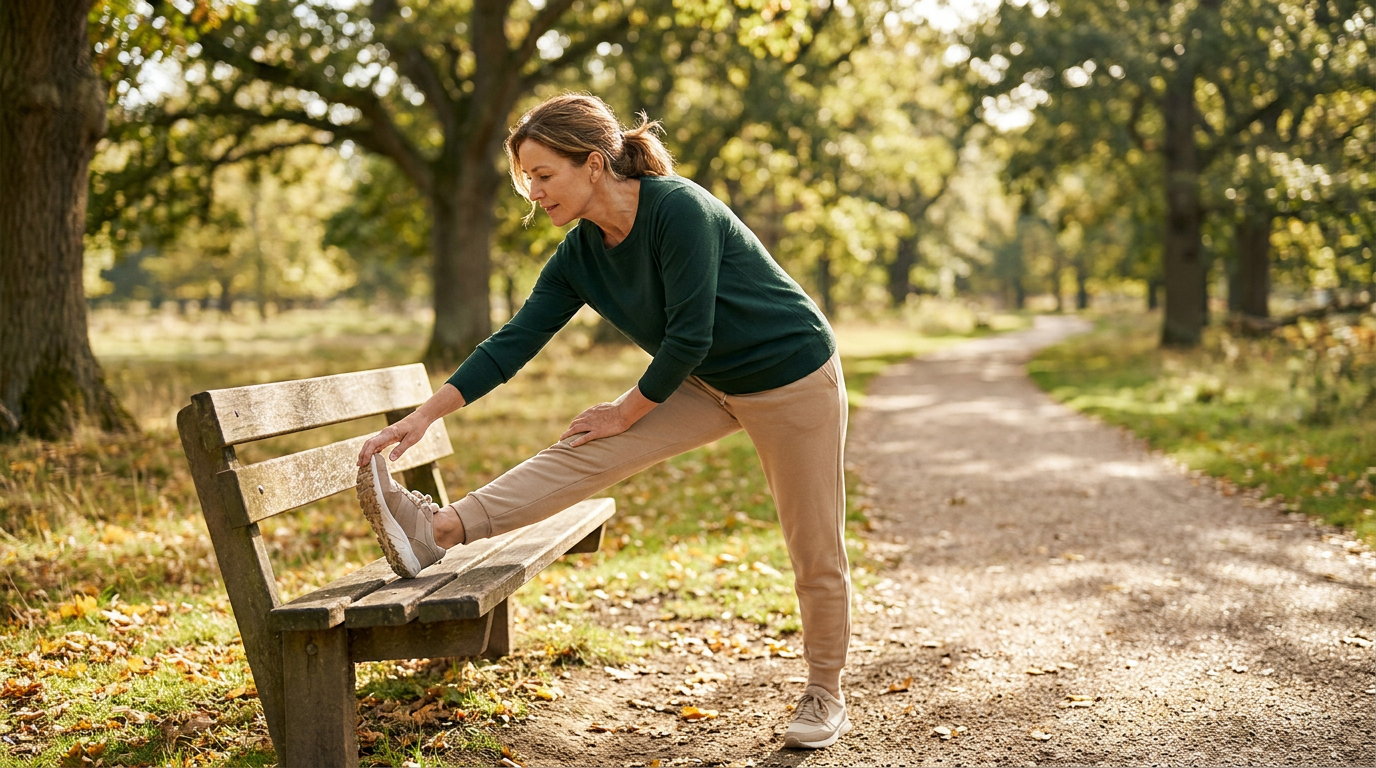
Midlife movement for women is often framed as a way to manage weight or preserve muscle. Its longer-term value may be broader. Recent research links physical activity and healthier blood glucose in midlife with slower cognitive decline later, while evidence on ageing joints indicates that avoiding movement can worsen pain, weakness and loss of mobility.
Together, these findings support a practical longevity principle: movement in the middle decades may help protect both the brain and the physical capacity required for independence. For women, however, the context matters. Perimenopause and menopause can alter sleep, body composition, insulin sensitivity, bone turnover and joint symptoms, all of which can affect how exercise feels and how consistently it is maintained.
Midlife movement for women and cognitive ageing
A recent longitudinal study reported that greater physical activity and healthier blood sugar levels in midlife were associated with slower cognitive decline decades later. The association was particularly apparent among Mexican American participants, an important reminder that social conditions, cardiometabolic risk and the effects of protective behaviours are not uniform across populations.
This does not prove that exercise alone prevents dementia. Observational research can identify long-term relationships, but it cannot fully separate movement from education, income, healthcare access, diet, sleep or existing health. Even so, the result fits a wider evidence base connecting physical activity with vascular health, glucose regulation and brain function.
Those pathways are especially relevant around menopause. Falling oestrogen can coincide with changes in fat distribution and insulin sensitivity, while hot flushes and disrupted sleep may make concentration and memory feel less reliable. Most subjective cognitive changes during perimenopause do not mean that dementia is developing. They do, however, make midlife a useful time to address modifiable risks such as inactivity, hypertension and persistently elevated glucose.
The study’s population-specific finding also deserves attention. Women are not a biologically or socially homogeneous group, and longevity advice derived mainly from affluent white cohorts may not transfer neatly to everyone. More research is needed to establish which forms and doses of activity offer the greatest cognitive benefit across ethnic groups and different health circumstances.
Joint pain is not always a signal to stop
Ageing cartilage becomes thinner and joint fluid changes over time, but inactivity is not protective. Cartilage depends partly on regular loading and unloading to exchange nutrients. Movement also strengthens the muscles around a joint, supports balance and helps preserve the range of motion needed for everyday tasks.
This matters because joint pain commonly becomes more noticeable in midlife, and many women report new musculoskeletal symptoms during the menopause transition. Hormonal change may contribute through effects on pain perception, inflammation, tendons and connective tissue, although the mechanisms remain incompletely understood. Osteoarthritis, previous injury, reduced muscle mass and changes in body composition may overlap with these hormonal influences.
Stopping activity altogether can create a cycle of deconditioning: weaker muscles provide less joint support, movement becomes harder, and confidence declines. Appropriate exercise can reduce osteoarthritis pain, although it may need to begin below the intensity a person previously tolerated. Walking, cycling, swimming, tai chi and yoga can build capacity with relatively low joint impact. Varied terrain may improve balance, but it is not suitable for every painful or unstable joint.
Pain also needs interpretation rather than dismissal. Mild muscular discomfort after unfamiliar exercise differs from sudden swelling, locking, instability, marked redness or pain that rapidly worsens. Those features merit clinical assessment. The longevity goal is not to push through every symptom, but to find a level and type of loading that can be repeated and gradually progressed.
Blood sugar links muscle, brain and long-term health
The cognitive research places blood glucose alongside physical activity rather than treating them as separate concerns. Contracting muscle takes up glucose, and regular exercise can improve insulin sensitivity. Over time, this may reduce exposure to the vascular and metabolic conditions associated with cognitive decline.
Menopause can complicate the picture. A shift toward more abdominal fat, loss of lean mass, poorer sleep and lower activity can collectively impair glucose control. A single fasting glucose measurement may miss early changes, while isolated wearable readings can be difficult to interpret without clinical context. Established markers such as HbA1c, fasting glucose, blood pressure and lipids remain more useful for assessing cardiometabolic risk.
Movement after meals may help moderate post-meal glucose, while resistance training creates and maintains metabolically active muscle. Aerobic exercise supports cardiovascular fitness, and balance work helps reduce fall risk. These forms of activity are complementary rather than interchangeable. Current evidence does not identify one perfect programme for female longevity, and relatively few long-duration trials are designed specifically around perimenopause.
Consistency matters more than an ideal workout
The most useful exercise plan is one that can survive fluctuations in sleep, symptoms, workload and recovery. Short periods of movement still have value, particularly when they replace prolonged sitting. For someone with joint pain or low current fitness, several brief bouts may be more sustainable than one demanding session.
Progress can be judged by function as well as minutes: easier stairs, steadier balance, less stiffness after sitting, improved walking tolerance or faster recovery after training. These changes may emerge before weight or appearance shifts. They are also more closely connected to healthspan, the years lived with mobility, cognition and autonomy intact.
For women navigating variable cycles or menopause symptoms, day-to-day performance is noisy. Sleep disruption, bleeding, hot flushes, pain and energy can all alter perceived effort. That variability does not erase progress, but it can conceal it when sessions are considered in isolation.
Training recovery, joint symptoms, energy and sleep quality only become readable when logged consistently over weeks. This is the kind of pattern Tulsy is built to surface.
Sources: ScienceDaily.
This content is for informational and educational purposes only. It is not intended to diagnose, treat, cure, or prevent any disease, and should not replace advice from a qualified healthcare professional.
Common questions
- Can exercise in midlife reduce my dementia risk?
- Exercise is associated with slower cognitive decline and supports vascular health, insulin sensitivity and brain function. It cannot guarantee dementia prevention, and much of the evidence is observational. Midlife activity is best understood as one modifiable factor alongside blood pressure, glucose, sleep, smoking status, diet and social connection.
- Should I exercise when my joints hurt during menopause?
- Complete rest often increases stiffness and weakens the muscles that support painful joints. Low-impact aerobic activity, strength work and mobility exercise can reduce osteoarthritis symptoms when appropriately scaled. Sudden swelling, locking, instability, redness or rapidly worsening pain should be assessed rather than exercised through.
- Why does blood sugar matter more after menopause?
- Menopause can coincide with reduced insulin sensitivity, more abdominal fat, disrupted sleep and loss of lean mass. Regular aerobic and resistance exercise can improve glucose handling, but individual response varies. HbA1c, fasting glucose, blood pressure and lipids provide more clinically meaningful context than isolated wearable glucose readings.
More on the research behind Tulsy in the science, or browse everything in Longevity.
References
Related reading
- Strength Training for Longevity: What Women Need to Know
Physical capacity may begin declining in the mid-30s, but later-life improvement remains possible. For women, effective strength work also requires measured recovery.
- Women’s Longevity After Menopause: What to Track Earlier
Menopause may involve concentrated physiological change rather than a slow, uniform transition. Sleep and activity patterns can add useful context, but long-term trends matter more than single readings.
- Menopause and Biological Aging: What the Ovary Reveals
New evidence links reproductive timing with biological age and shows that ovaries continue changing after menopause. Neither finding proves that menopause accelerates aging.
Get Tulsy Daily in your inbox